Have you ever heared words like React, Laravel, Supabase, and Firebase thrown around in forums and podcasts, but didn't know what actually mattered for your specific situation?
That was the exact situation I helped a non-technical founder with. They had $50K in runway, no technical co-founder yet, and needed to validate their idea with real users within three months. Picking the wrong stack would either burn through their budget with unnecessary complexity or box them into a corner when they needed to scale.
This happens all the time. Founders get paralyzed by technical choices because developers talk about frameworks like they're religions. The truth is, the best stack isn't the newest or the most powerful. It's the one that fits your specific situation right now.
This is the same framework I use when helping clients choose their stack. It works for any SaaS idea because it's based on business logic, not technical preferences.
Step 1: Clarify the Product Scope (Before the Tech)
Before we talk about any technology, we need to answer one question: what's the real goal of the MVP?
Are you validating an idea to see if anyone cares? Or are you building something scalable from day one because you already have traction? The answer completely changes what you should build.
Timeline defines complexity. If you're validating an idea, you need simple, fast, and flexible. Get something in front of users in weeks, not months. Learn what works, then rebuild it properly if needed.
If you're scaling existing traction, you already know the problem is real. Now you need maintainability and performance. You can afford to spend more time upfront because you're not guessing anymore.
Most founders mess this up by building for scale before they have users. They spend six months on architecture for a product nobody wants yet. Don't do that.
Step 2: Identify Core Requirements
It’s important what type of product you are building. A dashboard? A marketplace? A content platform? Each type has different technical needs.
What features matter most? Authentication? Payments? Real-time updates? Analytics? File uploads? Each feature narrows down your stack choices.
Here's how features map to technology decisions:
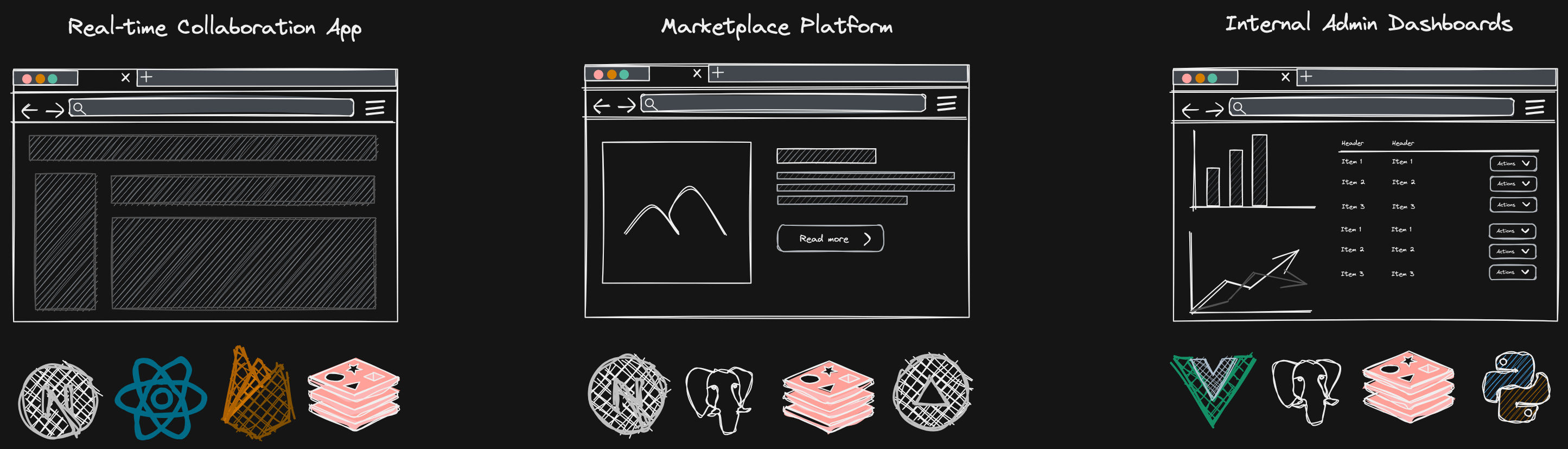
If you need real-time features like chat, notifications, or collaborative editing, you want Supabase or Firebase. They handle real-time data synchronization out of the box without you building complex WebSocket infrastructure.
If it's content-heavy with lots of blog posts, documentation, or marketing pages, use Next.js with a headless CMS like Contentful or Sanity. You get great SEO, fast page loads, and easy content management.
If it's transactional with complex business logic, user permissions, and data relationships, go with Next.js (or Node.js) plus PostgreSQL. You need a real database that handles relationships properly, not a document store.
If you're building a marketplace or platform connecting buyers and sellers, you'll likely need Next.js for the frontend, PostgreSQL for data, and Stripe for payments. These three together handle most marketplace needs.
Step 3: Match Stack to Skill & Resources
If the founder already has developers, what do they know? Don't make them learn an entirely new stack just because it's trendy. A developer who knows Vue really well will ship faster in Vue than struggling through React for the first time.
If you don't have developers yet and need to hire, choose something common. React and Next.js dominate the market, which means easier hiring and lower rates. Vue is solid but has a smaller talent pool. Angular is powerful but mostly used by enterprises. Svelte is promising but risky for hiring.
Avoid obscure or trendy stacks that limit hiring or raise development costs. I've seen founders pick the latest hot framework, then spend three months looking for a developer who knows it, then pay premium rates because the talent pool is tiny.
The best stack is one your team can actually maintain. If you have to explain your technology choices with "Well, technically it's better because..." you've probably overcomplicated it.
Step 4: Balance Speed vs Scalability
The reality is that you can't have everything. Every technology decision is a trade-off between how fast you can build and how well it scales later.
Fast to build, hard to scale: No-code tools like Bubble or Webflow, Firebase for everything, or rapid prototyping with minimal architecture. You can launch in days or weeks. Great for validation. But when you hit scale or need custom features, you'll rebuild from scratch.
Balanced: Next.js with Supabase or Prisma, or Vue with Firebase. You can build quickly because these stacks have great developer experience and pre-built features. They scale reasonably well. You'll hit limits eventually, but not until you have thousands of users. Perfect for most SaaS MVPs.
Slow to start, highly scalable: Custom backend with NestJS, NodeJS or Go, microservices architecture, carefully designed database schemas. Takes months to build properly, but handles millions of users and complex operations. Only do this if you already have proven traction.
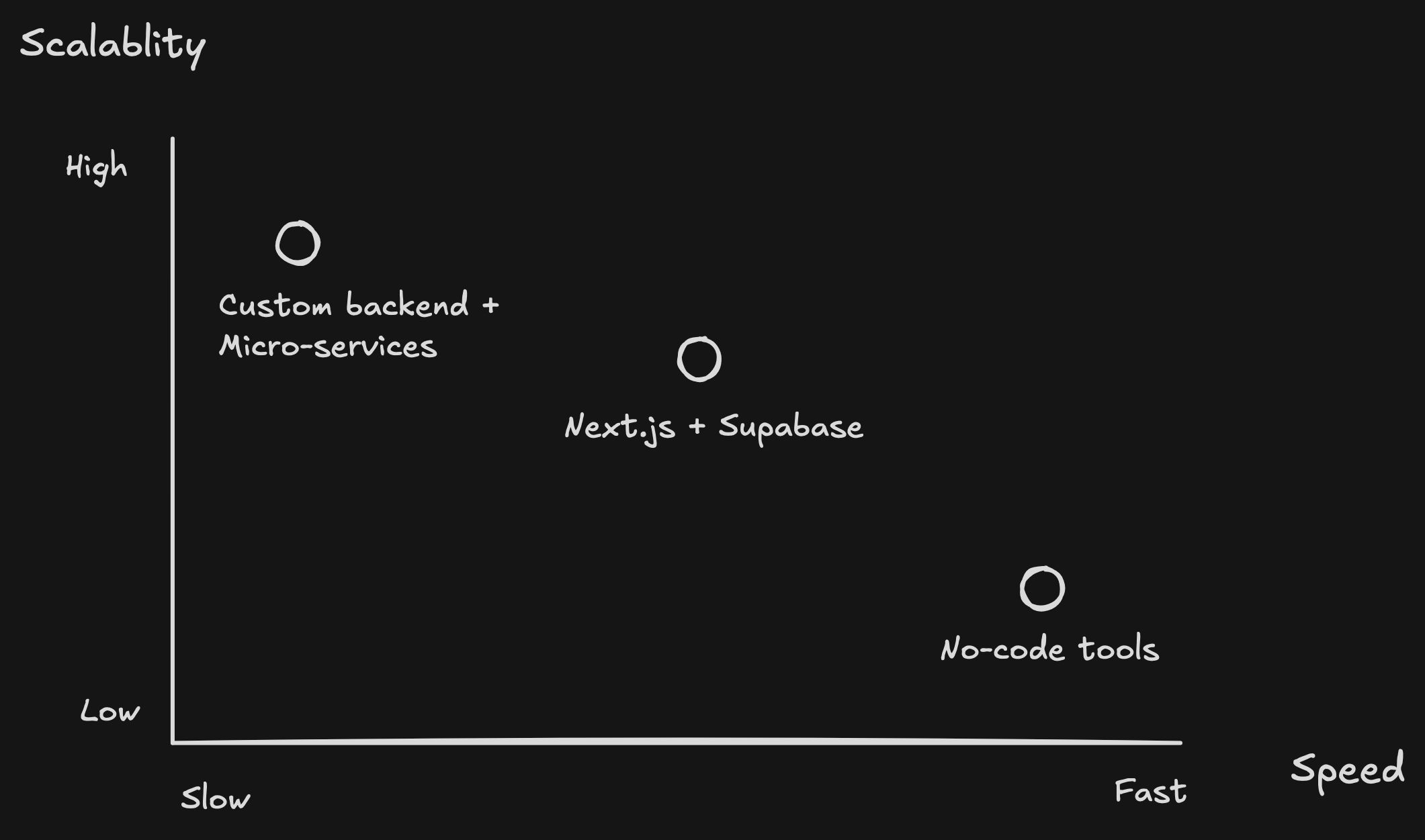
The right choice depends on how quickly you need to show results and how much technical debt you can afford later. Most startups should aim for the balanced approach. You can always migrate to something more robust once you've validated the idea and have revenue.
Step 5: Plan for Integration and Expansion
Think beyond the MVP. What tools will you need to integrate with later? Stripe for payments? Zapier for automation? Analytics platforms? Email services? CRM systems?
Modern stacks like Next.js with Supabase or Firebase make integrations predictable. They have well-documented APIs and active communities, which means when you need to connect something new, someone's already done it and shared how.
If you pick some niche framework or custom-built backend, every integration becomes a research project. You're reinventing wheels that other stacks give you for free.
Don't pick tech that boxes you in. Ask yourself: when we need to add payments, analytics, email, or third-party APIs in three months, will this stack make that easy or painful?
Step 6: Future-Proofing Without Over-Engineering
Founders hear "scalability" and immediately think they need to build enterprise systems. They start researching micro-services, message queues, and caching layers for a product with zero users.
You don't need that yet. You might never need it at all.
Here's my rule of thumb: if you can build it in a month and test it with users, that's the right level of complexity for now. If your developer is talking about architecture that takes six months before users can touch it, you're over-engineering.
The stack will evolve with the product. You're not making a permanent decision. You're making the right decision for the next 12 to 18 months. After that, you'll have users, data, and real requirements to guide the next technical evolution.
Linear started with Ruby on Rails. Notion started with React and a simple backend. Figma started with C++ for the editor but simple web tech for everything else. They all evolved their stacks as they grew. You will too.
Focus on shipping and learning. The technical debt you're worried about is cheaper than the opportunity cost of launching six months late.
Final Take: The Decision Filter
When you're stuck between options, run them through these three questions:
1. Does it help us ship fast?
If the answer is "well, eventually" or "after we set things up properly," that's a no. You need to be in front of users quickly. Every week of delay is a week you're not learning.
2. Can we maintain it with our current skill set?
Be honest. If you need to hire specialists or spend months learning, you're adding risk. The best stack is boring and proven for your team's skill level.
3. Will it scale for the next 12-18 months?
Not forever. Not for millions of users you don't have yet. Just for the next phase. Can it handle 1,000 users? 10,000? That's your target, not a million.
If a stack passes all three questions, it's the right choice for now. Notice I said "for now." This isn't a marriage, it's a tool. Use what works today, evolve when needed.
Real Example
Back to that founder I mentioned. Here's what we chose and why:
Their situation: B2B SaaS dashboard, needed authentication, data visualization, and simple payment integration. Budget of $50K, three-month timeline, no developers yet.
What we picked: Next.js for the frontend and backend API routes, Supabase for the database and authentication, Stripe for payments, Vercel for hosting.
Why it worked:
Next.js meant one framework for everything. No separate frontend and backend repos to manage. Easy to find developers who know React. Fast to build and deploy.
Supabase handled authentication in days, not weeks. Real-time database features came free. PostgreSQL gives proper relational data when they need it.
Stripe integration took hours, not days, because Next.js has great Stripe libraries and examples.
Vercel deployment is automatic and scales on its own. They don't need a DevOps person yet.
They launched in eight weeks. Got their first 50 users. Learned what features actually mattered. Now they're iterating based on real feedback, not assumptions.
That's what the right stack looks like. It disappears into the background and lets you focus on the product and users.
Next up: “7 Step Framework to Write a High Converting SaaS Landing Copy” Subscribe to get it in your inbox next week.